-


SPEED
EASY NAVIGATION
QUICK RESPONSES
DIRECT SHIPMENTS
GLOBAL SUPPORT-

-
EXCELLENCE
QUALITY SUPPLIERS
PROMPT SERVICE
SATISFACTION IS
#1 PRIORITY -

-
ECONOMICS
LOWEST PRICES
FREE FREIGHT
QUICK DELIVERIES -

-
KNOWLEDGE
FACTORY TRAINED
OTJ EXPERIENCE
ENGINEERING SUPPORT
Hayward Ball Valve Selection Guide
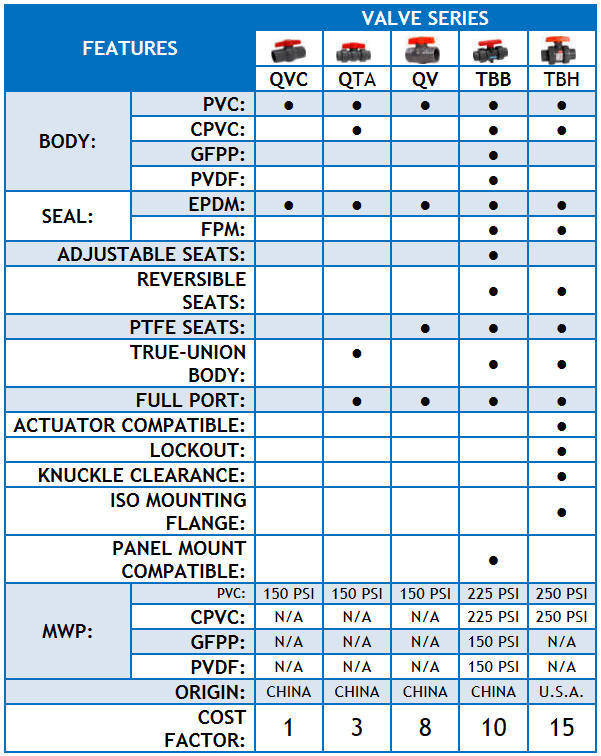
Hayward offers several lines of PVC and CPVC ball valves ranging from economical compact models to full-featured industrial true-union valves. Use the guide below to compare series and select the best option for your needs.
Quick Series Comparison
Hayward ball valves generally fall into these main categories:
- QVC Series — Economy 1-piece compact valves for light commercial use (pools, irrigation, plumbing).
- QTA / TBB Series — True-union economy to mid-range valves with good features and value.
- TBH Series — Premium industrial true-union valves with the most features, highest pressure rating, and actuation capability. Made in the USA with fast availability.
The TBH series is the most popular choice for industrial and process applications because it can be actuated, has higher pressure ratings, and offers the broadest range of options and accessories.
How to Select a Ball Valve for Your Application
- Select compatible materials — Choose the right body material (PVC, CPVC, etc.) and o-ring/seat material (EPDM or FPM/Viton) based on the fluid being handled. See our Ball Valve Materials Guide and O-Ring Materials Guide.
- Determine connection type — Threaded, socket (glued), or flanged. Note that only the TBH series offers flanged connections as standard.
- Consider pressure and temperature — Check the required pressure rating and maximum temperature of your system.
- Decide on port style — Standard port vs full port (full port has lower pressure drop).
- Actuation needs — Will the valve be manual or actuated? The TBH series is best suited for automation.
- Additional features — Lockout/tagout, stem extensions, special seals, etc.
Important Considerations
- All Hayward ball valves use o-ring seals. You can choose between FPM (Viton) or EPDM depending on chemical compatibility.
- The TBH series is manufactured in the USA and typically ships very quickly, even for larger orders.
- Economy series (like QVC) are great for cost-sensitive commercial applications but are not designed for heavy industrial cycling or demanding process conditions.
Need Assistance?
If you’re unsure which series or material is best for your application, our team is happy to help. We can review your media, pressure, temperature, and connection requirements.